In 19th century, Washington papers sometimes carried stories about a place called Bryantown. Its location, between the Presbyterian and Catholic burial grounds in the northwestern section of Georgetown, was not considered fashionable, and small frame houses easily outnumbered brick mansions. The population was primarily working class, and included a substantial number of African Americans. While some stories about spoke of improvements, by the end of the century it was far more likely that readers associated Bryantown with accidents, fires, and bad behavior. After that, the well-known combination of real estate development, residential zoning, and racial covenants caused the name of this “old established locality” (“Affairs in Georgetown,” Evening Star, August 27, 1898, p. 4) to be all but forgotten.
(For more information on some of the families that lived there, see Bryantown Families.)
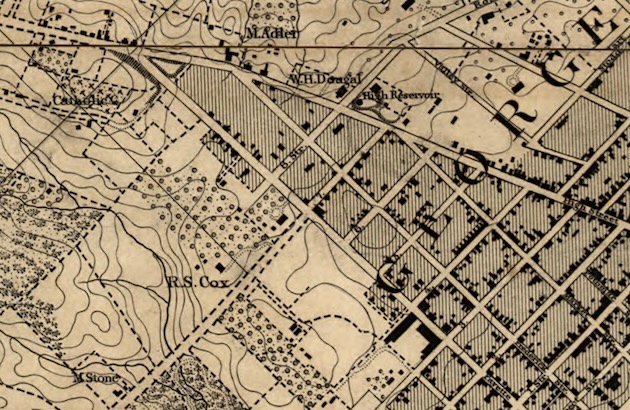
The northern end of Georgetown, as it appears in the Boschke map of 1859.
Origins
The name Bryantown can be traced to a land transaction at the northeast corner of Fayette and Eighth (35th and R) Streets in which the seller was John Threlkeld, and the buyer was a contractor named Bryan Duffy. At about the time of that 1807 transaction, Duffy donated material for the plastering of the new Georgetown College. He was later remembered in connection with excavation work on Analoston Island, and that his son was the builder of the second Holy Trinity Church in 1851. Duffy’s 1813 will referred to his Georgetown lots, and the houses he built on them, as “Duffy’s Town, on Fayette street.” Georgetown assessments of 1818-1819 listed Brian Duffy (“dec’d”) as the owner of a lot on Fayette Street north of 8th, and his widow Elizabeth as the landlord of three frame houses on the west side of Frederick (34th) Street north of 8th Street. The 1830 directory lists “Duffey Elizabeth, Widow, Fayette st above Eighth.” For a time, the neighborhood went by two names; while Dr. Charles Worthington’s 1836 will still refers to “sundry lots on Fayette St. in Duffy’s Town,” but, just two years earlier, a grim entry in the death register of Holy Trinity Church had recorded the death of an “Anon. col’d child, 4 mos., found in Bryan Town.”
John Threlkeld to Bryan Duffy, DC Liber S18 (1807) f. 113/93; Bryan Duffy, 1813, DC Wills, box 4, Wesley Pippenger, District of Columbia Probate Records, 1829-1840 (1996), p. 205; Holy Trinity Death Register, November 28, 1834; Charles Worthington, 1836 DC Will, box 13; Elizabeth Duffy, 1820 Census, Georgetown, D. C., p. 53; Eliza.h Duffy, 1830 Census, Georgetown, D. C., p. 197. Bryan Duffy is mentioned in David Bailie Warden, A Chorographical and Statistical Description of the District of Columbia, 1816, p. 136; and in Fr. McElroy to Fr. Stonestreet, December 30, 1856, cited by Joseph Zwinge, S. J., The Novitiate in Maryland, Woodstock Letters, Volume XLIV, Number 1 (February 1, 1915).
How far from Bryan Duffy’s house his name came to be applied emerges from press. In 1846, a house was advertised that was “in Bryantown, opposite Mr. E. A. Eliason’s tanyard.” This was confirmed eight years later, when Eliason’s residencewas described as being in “that portion of our city, known as Bryantown.” Eliason’s tanyard was at what is now the Georgetown Safeway, at 1855 Wisconsin Avenue. In 1898, a press report of “a number of diphtheria cases in the northwestern part of Georgetown” explained that disease was prevalent “in the belt north of Q street and west of 32d street, including a large portion of the town known as “Bryantown,” an old-established locality.” Q Street and 32nd Street became Volta Place and Wisconsin Avenue in 1905.
“For Rent,” Georgetown Advocate, April 21, 1846, p. 5; “Georgetown Correspondence,” Evening Star, November 29, 1854, p. 3; “Affairs in Georgetown,” Evening Star, August 27, 1898, p. 4; “New Street Names,” Evening Star, June 6, 1905, p. 16. It is worth noting that the 1898 description in the Evening Star, “‘Bryantown,’ an old-established locality,” was altered by Mary Mitchell in 1978 to include a spelling only rarely seen in 19th century newspapers: “the old established locality called Bryantown, or ‘Brinetown.’” By 1986, when Mitchell published Chronicles of Georgetown Life (1986), she had settled on the latter: “a black shantytown called “Brinetown” had thrived on these open spaces.” In 1991, the authors of Black Georgetown Remembered cited Mitchell when they wrote that “the purchase of the land located in old “Brinetown” meant that the black neighborhood there ceased to exist.” (See Mary Mitchell, “Black Residential Patterns in Georgetown, 1860-1900,” unpublished manuscript, ca. 1978, Peabody Room, Georgetown Branch Library, p. 18; Mary Mitchell, Chronicles of Georgetown Life, 1865-1900 (1986), pp, 8, 92; Kathleen M. Lesko, Valerie Babb, Carroll R. Gibbs, Black Georgetown Remembered (1991), pp. 21, 45.)
In 1835 the city of Georgetown applied to the Levy Court of Washington County for a public road, to “commence on Fayette Street, at the end of Seventh Street,” which would intercept the existing road to Chain Bridge and connect the upper end of Georgetown with the farms of Virginia. The purpose of the New Cut Road may have been intended to divert nuisances––such as herds of livestock on their way to slaughterhouses at the northern end of Georgetown––from the commercial center of the city. That the status of property along what is now Reservoir Road would not have been improved by the additional traffic is safe to guess. The only amenity of this neighborhood that periodically made the news was a municipal pump––described in Georgetown Ordinances as being “at Bryantown” ––that supplied it with water (and was not always reliable). “There is a sick pump at the corner of Fayette and Seventh streets, Georgetown, generally known as the ‘old bear pump,’ on which the residents of the neighborhood rely for water. A visit from the pump doctor would be hailed with much gladness. The teetotalers now have to travel about five squares for a ‘drink’ of water.” (The pump was in service until 1910.)
“By the Levy Court of Washington County,” National Intelligencer, February 12, 1835, p. 3; Georgetown Ordinances, July 1, 1865; Georgetown Courier, April 3, 1869; “City Brevities,” National Republican, December 2, 1876, p. 5; “Georgetown Streets,” Evening Star, June 10, 1905, p. 3; “Urges District Wells,” Washington Herald, October 24, 1910, p. 10.
Tanyards
If the fact that Bryantown was bounded at the north and south by burial grounds was not a selling point, it was even worse that it was also located between two tanyards that operated on the periphery of Georgetown. The tanning procedure (which drew its water from small streams that now run underground) involved soaking hides in a succession of sunken vats, where hair was loosened from them with lime, and the lime was removed with lant––aged urine––and bate, a fermented brew of salt, potash, water, and dung from poultry, pigeons, or dogs. There were also vats where scraps of hide would be allowed to decompose, and the results boiled down to make glue. Runoff and sludge were sent downstream. It was, all in all, an industry best kept on the periphery. But leather was the indispensable material for making shoes, boots, saddles, harnesses, books, luggage, furniture, and countless other useful things, so tanneries were, by and large, a welcome addition to the industries of a town. All that was asked of this malodorous trade was that it should be situated on the outskirts of town, and among the poor, who supplied its labor.
Journal of the Columbia Historical Society, 20:126; Edgar R. Hon, “Lost Tanyards: Rediscovered in Fairfax County,” Yearbook of the Historical Society of Fairfax County, Virginia, Vol. 25, 1995-6; Richard P. Jackson, Chronicles of Georgetown, 1751-1878, pp. 106-7;Rev. Laurence J. Kelly, S. J., History of Holy Trinity Parish, Washington, D.C., 1795-1945 (1945), p. 38.
The tanyard at the northern end of (what would be known as) Bryantown announced its arrival in 1797 by advertising a large assortment “Consisting of sole leather, leather of Spanish and country hides, upper leather, calf skins and sheep skins, all well tanned and dressed, for which cash or raw hides and skins will be taken in payment at moderate prices. The subscriber wishing to carry on the tanning business pretty largely, hopes to meet with encouragement. Thomas Hyde, Tanner.” Customers could inspect these goods at the new tanyard now open for business “just above Georgetown, on the road leading to Montgomery Court House.” Although Hyde’s property––“about ten acres of land, in an excellent state of cultivation, a neat and convenient dwelling and outhouses of brick, and a well arranged Tannery, with every convenience for doing extensive business”––was advertised for sale in 1822, it seems to have remained his through 1830, when the Georgetown directory listed “Hyde Thomas, Currier, High st.” Hyde died in 1841. “In Georgetown, D. C. on Friday, 16th April, Mr. Thos. Hyde, aged 74 years and 20 days, and for nearly half a century a citizen of that place. The friends and acquaintances of the family are respectfully invited to attend his funeral from his late residence on High street this (Saturday) afternoon, at half past 4 o’clock.” He was succeeded in business by his son, Thomas William Hyde, who lived at 1319 30th Street, where a pithy description of the family trade was found in 1942: “Hyde is my name, and hides I buy, 3 cents for wet ones, 5 cents for dry.” The Hydes were succeeded by Elias Asbury Eliason, who went out of business in 1870. “The tanyards, with all the improvements and appurtenances, known as Eliason’s tannery, at the corner of High and Market streets, has been sold, by Thomas Dowling, auctioneer, to L. C. Kengla, for $8,250.” Eliason stayed on at 302 High Street, his residence adjoining the business, and died in 1872. The property was sold in 1887. “John J. Bogue, real estate broker has sold … lots 42 and 250, B. & H.’s addition, square 129 (known as Eliason’s tannery), for Wm. Homiller, to N. S. Kenyon, for $5,000.”
“For Sale,” Georgetown Centinel of Liberty, October 10, 1797, p. 1; “Public Sale,” National Intelligencer, September 3, 1822, p. 3; “Deaths,” National Intelligencer, April 17, 1841, p. 3; “Georgetown,” Evening Star, April 22, 1870, p. 4; “Funeral,” National Republican, August 3, 1872, p. 4; “Affairs in West Washington,” Evening Star, May 21, 1887, p. 6; Christian Hines, Early Recollections of Washington City (1866), p. 9; Richard P. Jackson, Chronicles of Georgetown, 1751-1878 (1878), pp. 106-7; Elmer Epenetus Barton,Historical and Commercial Sketches of Washington and Environs (1884), p. 193; William A. Gordon, “Recollections of a Boyhood in Georgetown,” Records of the Columbia Historical Society, Vol. 20 (1917), p. 126; Rev. Laurence J. Kelly, S. J., History of Holy Trinity Parish, Washington, D.C., 1795-1945, p. 38; Deering Davis, Stephen P. Dorsey & Ralph Cole Hall, Georgetown Houses of the Federal Period, Davis, Dorsey, and Hall (1944), p. 106.
As early as 1808, there were also two tanyards to the south of Bryantown, of which the northernmost was at what is now 35th Street and Volta Place, and the other at the southwest corner of 35th and O Street. “Money Found––On Thursday, the 26th instant, between my upper and lower Tanyard, a purse containing a sum of money. The owner may have it again by giving a proper description of the purse and its contents, and paying the price of this advertisement. Isaac Dawes.” The tanyard was for sale in 1813.
“I offer for sale or rent, that Valuable Tan Yard (formerly the property of Isaac Dawes), fronting on Fayette and Fourth streets, Georgetown, now in the occupation of Mr. Staley. In said yard are sunk thirty-three vats, all of which are nearly new. A valuable pump, and a constant stream of water passing through the yard––On this property there is erected a substantial brick bark-house, which will hold two hundred cords of bark, and a first rate bark mill, with the addition of a brick building, finished for a family, and calculated for every branch of the tanning and currying business.––Attached to said property is a large Two–Story Brick Dwelling; together with a dairy, garden, and stable. The situation is one of the most eligible for the tanning business, and rendered desirable by the great demand for leather, beyond the ability of different yards in this place to supply.”
That the upper tanyard was on both sides of Fayette Street was confirmed in 1819, when Isaac Dawes owed taxes on “part of lot 172, part of lot 173 in Peter, Beatty, Threlkeld & Deakins’s addition to Georgetown.” The property was advertised again in 1823 and was among John Threlkeld’s holdings when he went bankrupt in 1826.
“I wish to sell or rent, that fine Tannery, on Fourth street, Georgetown, opposite the Monastery; it has sixty vats, and all necessary buildings. Any quantity of hides and bark can be obtained on the spot. A further description is deemed unnecessary, as any person wishing to embark in the business, will call and view the property. The terms will be made easy. For Adam Robb, John N. Robb.”
“By virtue of … writs of fieri facias … I shall expose to public sale … lots Nos. 172, 173, in [Threlkeld’s] addition, on Fayette and Fourth streets … Seized and taken in execution as the estate and property of John Threlkeld, and will be sold to satisfy debts due by him to the Union Bank of Georgetown, …Tench Ringold, Marshall, D. C.”
It was at this point that lot 172 would have become available to the Visitation Convent. Lot 173 passed from banker Clement Smith to Mary Fenwick in 1835.
“Money Found,” Washington Federalist, Georgetown, June 29, 1808, p. 4; “Tan-Yard,” Federal Republican & Commercial Gazette, Georgetown, March 15, 1813, p. 3; “Notice Is Hereby Given,” National Messenger, Georgetown, March 31, 1819, p. 3; “A Tan Yard for sale, or Rent,” National Intelligencer, February 22 1823, p. 1; “Marshall’s Sale,” National Intelligencer, December 22, 1826, p. 1; “Tanyard For Sale,” National Intelligencer, March 5, 1834, p. 1; “Tanyard At Auction.––Trustee’s Sale,” National Intelligencer, October 24, 1843. p. 3; “Valuable Tanyard At Auction,” Georgetown Advocate, Oct 16, 1845, p. 3; “Real Estate In Georgetown At Auction,” National Intelligencer, Oct 16, 1852, p. 2.; Tench Ringgold, Marshall, to Clement Smith, DC Liber WB20 (1820) f. 644; Clement Smith to Mary Fenwick, DC Liber WB58 (1835) f. 66; Julia Fenwick to Clare H. Mohun, DC Liber 126H (1887) f.313.
By 1834, what had earlier been Isaac Dawes’s lower tanyard, at 35th and O Street, came up for sale. “The subscriber wishing to retire from business in Georgetown, and remove to the country offers for sale that well known establishment in said town, and near the College. The buildings are extensive and commodious for that purpose, and contain several vats, but may be enlarged to any extent that may be wanted. There is also a comfortable dwelling house, and a good brick stable.” In 1843, after its owner had died, a trustee’s sale to pay “certain debts ascertained to be due from the estate of John Baker” was advertised. “The area of lots 79, 80, and part of 81, which front on Fayette street, is the site of the valuable Tanyard so long and successfully worked by Mr. Baker.” The property went on the block again in 1845. “The improvements consist of a two-story brick warehouse, a brick bark house, &c., 77 vats, with 7 lime pools.” By 1852, when the “very desirable piece of property at the corner of Fayette and 2d streets, formerly known as “Baker’s Tanyard,” was once more up for auction, its highest and best use was assumed to be residential. “The substantial brick buildings on this property could, at very small cost, be converted into two or three excellent dwellings, (and room enough for as many more,) which, under the present demand therefor, to say nothing of the rapidly increasing value of property, would yield to the purchaser a very handsome remuneration.”
“Tanyard For Sale,” National Intelligencer, March 5, 1834, p. 1; “Tanyard At Auction,” National Intelligencer, October 24, 1843, p. 3; “Valuable Tanyard At Auction,” Georgetown Advocate, October 16, 1845, p. 3; “Real Estate In Georgetown At Auction,” National Intelligencer, October 16, 1852, p. 2; Rev. Laurence J. Kelly, S.J., History of Holy Trinity Parish, Washington, D.C. 1795-1945 (1945), p. 38.
By the middle of the 19th century only the tanyard north of Bryantown was still in operation; from the census, which began to list occupations in 1850, one can learn who worked there. Most of the men listed as tanners or curriers––John F. Tracy, John Elkins, William Whalen, Wesley Clements, Frederick Lukei––lived at the northern end of Fayette Street and were white. The 1858 directory and the 1860 census show a Black tanner named Samuel Berry living at 364 High Street, just above the tannery––a connection that is confirmed by records showing that members of the Berry family had been freed by John Eliason in 1824. There is also evidence that the tanyard rented enslaved labor. In 1833, a reward was advertised for “a yellow Boy, named Tom… about 15 years old” who ran away. “His clothes were indifferent, having left the Tannery near Georgetown, where he was hired, without the intention, probably, of running away. There is reason to believe he went off in a Pennsylvania wagon, and took the route through Frederick and Hagerstown.” A fifty dollar reward was offered by “G. T. Rhodes, Georgetown, D. C.” And there is no reason to doubt that Eliason hired slaves from a slaveholder who lived within sight of his tanyard: in 1862 Margaret Barber reported that Andrew and Townley Yates, two “good curriers,” earned her $120 a year. The decline in the industry in the second half of the 19th century can be gauged by the declining number of tanners living in the vicinity. The 1850 census had listed seven: John F. Tracy, John Elkins, Frederick Lukei, William Whaling, S. Ridgely, and William Eli (in the Poor House). By 1860, there were still three––John F. Tracy, John Elkins, and Samuel Berry––and in 1880, just two––Walter Payne and Ira Nicholson.
“50 Dollars Reward,” National Intelligencer, November 12, 1833, p. 3; “50 Dollars Reward,” National Intelligencer, March 19, 1834, p. 4; 1850 Census, North West Ward, Georgetown, D. C., pp. 177-178; 1860 Census, Ward 2, Georgetown, D.C., p. 98; Dorothy S. Provine, District of Columbia Free Negro Registers, 1821-1861; Petition of Margaret C. Barber, May 22, 1862, in Records of the Board of Commissioners for the Emancipation of Slaves in the District of Columbia, 1861–1863, National Archives.
Improvements
In 1853 the Georgetown correspondent of the Evening Star suggested some improvements needed by the residents at the northern end of Georgetown. “A house for religious worship provided with free pews, situated near the residence of E. A. Eliason, for the accommodation of that portion of our citizens who reside in what is now known as Bryan Town and Pole Hill. In this section there reside from one to two thousand very worthy people, who are located so far from any church that it is almost impossible for them (especially females) to attend any place of religious worship at night, or during inclement weather. Next we would name a public school in the same locality. Here there are scores of bright-eyed little ones, the children of worthy poor people who, we have no doubt would be glad to have them properly educated, but are deprived to some extent of the privilege, by the fact that the town school is too far removed from them to admit of their attending except in mild and pleasant weather. We make these suggestions in the hope that the benevolent of the town may be induced to take these important matters into serious consideration, and try to raise the means for their establishment.”
“Georgetown Correspondence,” Evening Star, July 26, 1853, p. 4.
Just one year later, Bryantown appeared to be moving up in the world. “That portion of our city, known as Bryantown, has also improved very much recently, and the residences of Messrs. Duffy & Morris Adler & E. A. Eliason, Esqs., situated here, are not among the least of the many beautiful dwellings with which our city abounds.” (Bryan Duffy’s son Matthias was the developer of a “suburban villa,” at what corresponds to 3315-3317 R Street, that was first put on the market in 1845. Elias Asbury Eliason lived adjacent to his tanyard on High Street, at what is now 1855 Wisconsin Avenue. As Morris Adler lived in an older house at what is now 1821 Wisconsin Avenue, it is more likely that the correspondent was referring to the house then being built for Adler’s son-in-law, William Dougal, at what is now 3259 R Street, on the southern part of Adler’s property.) This was the only time, however, that any well-to-do families were ever mentioned in connection with Bryantown.
“Heights of Georgetown,” Georgetown Advocate, October 14, 1845, p. 6, November 13, 1845, p. 3; “For Sale Or Rent,” National Intelligencer, September 21, 1847, p. 2; “Georgetown Correspondence,” Evening Star, November 29, 1854, p. 3; “Died,” National Republican, April 1, 1873, p. 3; Georgetown Courier, April 19, 1873; John Baltzer’s heirs to Morris Adler, land out of Rock of Dumbarton, and lots 11 and 12 of The Slip, DC Liber WB 82 (1840) f. 333/229; Dougal House, HABS DC-837.
Most stories connected with Bryantown, and the part of Georgetown above it, were a good deal less flattering. In 1854 there was this news from above the intersection of Fayette and Madison Streets. “We have been requested by several persons living in the neighborhood, to call the attention of the Mayor and his police to the disorderly scenes which frequently occur at a couple of houses situated on the hill, just beyond Mr. E. A. Eliason’s tannery, where a parcel of persons, negroes and others, are in the habit of meeting at night and spending their time drinking, cursing, swearing and fighting, to the great annoyance of the neighbors, especially on Sunday nights. What has become of the law of our corporation, which prohibits the keeping open of such places on the Sabbath?” A similar item from north of the burial ground appeared in 1857. “A colored man named Ridgley, bar-keeper for Temple Sherwood, on Pole Hill, at the upper end of High street, was arrested this morning by officer Trunnel, for assault and battery on a servant man of Dr. Anderson’s, of Rockville.” This was still the case, ten years later. “Fighting In A Grave-Yard. ––We are informed of a little affair that took place in a grave-yard, near what is called Pole Hill, beyond Bryantown, on Tuesday night.”
“Georgetown Correspondence,” Evening Star, August 16, 1854, p. 4; “Police Intelligence,” The States, August 6, 1857, p. 3; “Fighting In A Grave-Yard,” National Republican, August 2, 1867, p. 4.
During the Civil War, any area on the periphery of the city would have been where the refugees from slavery called contrabands took shelter, but we only have a glimpse of these events. In July 1862, the abolitionist Rev. Moncure Conway––pastor of the First Congregational Church of Cincinnati, and black sheep of a slaveholding Virginia family––reunited with twenty-nine of his father’s slaves who had just crossed the Potomac River and were sheltering in a cabin “in the farthest suburb of Georgetown.” “They were crammed into the two ground rooms, the children sleeping wherever they could find a place for their weary heads, and several mothers had babes at their breasts.” (Conway, making the most of his rights as their owner’s son, took them North by train, to settle in Yellow Springs, Ohio.)
Moncure Daniel Conway, Autobiography, Memories and Experiences (1904) vol. 1, pp. 355, 357-363; John d’Entremont, Southern Emancipator: Moncure Conway, the American Years 1832-1865 (1987), 167-171.
Methodist Missions to Bryantown
Regarding the unmet religious needs in Bryantown, the correspond is likely to have been aware that plans were underway.As early as 1845 the Montgomery Street Methodist Episcopal Church had proposed establishing a mission and Sabbath school to serve the needs of the residents of “Bryantown, West Georgetown,” but the attempt faltered, and it wasn’t until 1852, when the will of Thomas Brown left land for its construction at the southeast corner of Fayette and Seventh Streets. Funds were being raised in 1855. “The fair for the benefit of the Briantown Mission Sabbath School is moving on finely, and their rooms are nightly crowded. Their success so far has exceeded their expectations, and the only regret is that they have not more room for the accommodation of visitors and the display of their many useful and fancy articles.” The brick chapel––with an “end gallery for the accommodation of colored persons”––was dedicated in 1856. In 1860, the congregation numbered 195, of whom 25 were Black. In 1871 the congregation observed Independence Day with a picnic at Burleith. “Sunday School Celebrations Of The Fourth. ––The West End Georgetown Methodist Church, on the corner of Fayette and 7th streets, will celebrate the day at the woods of R. S. Cox.” A parsonage, built next door in 1866, was sold in 1872––possibly in connection with a case brought by “Trustees et al, vs. Congregation of West Georgetown Methodist Church. Decree authorizing trustees to sell.” In 1873 the church spent $2000 to remodel its facade. The church roof was torn off twice––by a winter gale in 1876, and by a summer tornado in 1878. The church reopened under a new name –– “Calvary, formerly West Georgetown M. E., corner 35th and T streets” –– in 1884 but struggled to stay open. By 1893, noting that only twenty parishioners were left, the trustees of Dumbarton Church, in whom the title was vested––and who were building a new church on Dumbarton Avenue––decided to sell. A suit against the trustees by the congregation was settled out of court in 1898, and the church was razed.
“Georgetown Correspondence,” Evening Star, February 23, 1855, p. 3; “Georgetown Correspondence,” Evening Star, June 4, 1855, p. 4; “Dedication,” Evening Star, May 16, 1856, p. 2; “Georgetown,” Evening Star, May 17, 1858, p. 3; “Georgetown Corporation Laws,” Evening Star, April 14, 1859, p. 3; “Georgetown,” Evening Star, February 21, 1860, p. 2; “Building Improvements,” National Intelligencer, October 23, 1866, p. 3; “Georgetown,” Evening Star, July 3, 1871, p. 5; “Georgetown,” Evening Star, July 13, 1872, p. 4; “The Courts,” National Republican, July 24, 1872, p. 4; “Georgetown,” Evening Star, October 15, 1873, p. 4; “A Church Unroofed,” Evening Star, February 4, 1876, p. 4; “Georgetown,” Evening Star, Aug 12, 1878, p. 4; “Religious Notices,” Daily Critic, May 17, 1884, p. 3; “Religious Notes,” Evening Star, October 4, 1884, p. 4; “Georgetown,” Evening Star, April 20, 1893, p. 8; “A Church Incorporated,” Evening Star, May 31, 1894, p. 4; “About Georgetown,” Evening Star, September 22, 1894, p. 6; “Annual Conference,” Evening Star, March 3, 1898, p. 3; “Affairs In Georgetown,” Evening Star, August 18, 1898, p. 13; “Affairs in Georgetown,” Evening Star, August 27, 1898, p. 4; “Makes Haste Slowly,” Evening Star, April 6, 1903, p. 10; William Martain Ferguson, Methodism in Washington, District of Columbia, (1892), p. 172; Joseph. W. Kirkley, “A Centennial Sketch of Methodism in Georgetown, D.C.” (1884), and Rev. Lloyd G. Davis, “A Brief History of the Founding of Methodism in Georgetown December 24, 1772” (1941), Peabody Room, Georgetown Branch Library; West Georgetown School, 1640 Wisconsin Avenue, N. W. (Georgetown), HABS No. DC-110.
In 1874, a different Georgetown Methodist congregation, the Congress Street Church on 31st Street, established a mission at the intersection of what is now 35th Street and Wisconsin Avenue. “The Methodist Protestant denomination of this city are erecting a mission chapel at the intersection of Fayette and High streets, The building is a frame structure, 25x 55 feet, with a recess pulpit. The style will be gothic, with a steeple 48 feet high. The interior will be finished with fresco, except the ceiling, which will be of hard wood, oiled. They expect to complete the building in a few weeks, when it will be formally dedicated, and placed in the charge of the Rev. Mr. Weigan, who was added to the Georgetown appointments at the close of the conference last evening.” Congress Street’s interest in this section of Georgetown can be traced to the fact that Elias Asbury Eliason, who had operated the tannery on High Street for many years, was the son of one of its founders, John Eliason, and that several of the more prosperous butchers who had their pens and slaughterhouses in the vicinity of the tannery, and who supplied it with hides, were trustees of Congress Street. It was the butchers who took the lead in funding the chapel. “At the Annual Conference held at Congress Street church in 1874 Mr. B. F. Hunt, Sr., arose and announced that he would contribute $500 toward instituting a Mission on Georgetown Heights. The church owes its existence largely to Mr. Joseph Weaver, who contributed the plot of ground on which it stands. He reared a large family on Wisconsin Avenue, just across the street, on the site where three of his surviving sons and his only daughter now have handsome homes. Mr. Henry Weaver, whose home was where his daughter, Mrs. Philip T. Hall, still resides, contributed most of the finances.” Joseph and Catherine Weaver’s donation was recorded in a deed. “Whereas it has been in contemplation by the said parties of the second part to erect a house of worship of Almighty God according to the form of service of the said Methodist Protestant Church in that part of said Georgetown in which are situated the premises hereinafter conveyed.” Funds were still being raised in 1877. “Supper for the Benefit of the Mt. Pleasant M. P. School, Corner Fayette and High streets, to be given at Mr. Joseph Weaver’s New Building, corner High and Road streets, Georgetown Heights.” (“New building” refers to Weaver’s renovation of Mount Hope, at 3308 R Street, which he had acquired in 1876.)
“Georgetown,” Evening Star, March 19, 1874, p. 6; “Improvements,” National Republican, May 25, 1876, p. 2; “Georgetown Adverm’ts,” Evening Star, February 20, 1877, p. 4; Minutes, Congress Street Methodist Protestant Church, May 5, 1873; “Fiftieth Anniversary At Mt. Tabor, Washington D.C.,” The Methodist Protestant (Baltimore, Md., 1842-1929), June 11, 1924; St. Luke’s United Methodist Church Archive, Wesley Theological Seminary Library; DC Liber 744, (1874) f. 382.
In 1876, Rev. Philip T. Hall presided as the Methodist Protestant Sabbath School of Mount Pleasant commemorated Independence Day with the dedication of a stone in front of the chapel. The young pastor married two years later. “Miss Mary Weaver, daughter of Henry Weaver, esq., and Rev. Philip T. Hall, of Baltimore, were united in marriage yesterday evening at the home of the bride, on the heights.” The chapel acquired a new name in 1885. “The Mt. Pleasant M. P. mission has severed its connection with Congress-street church, assumed the name of “Mt. Tabor M. P. church.” “The Ladies of the Mt. Tabor M. P. church will have an Oyster supper at the residence of Mrs. B. F. Hunt, Georgetown Heights.” The floorplan was extended by a transept in 1888. “The addition and improvements to Mount Tabor M. P. Church having been completed, services were held there yesterday.” The support of the prominent butcher families continued into the next century. “The Musicale and lawn fete given last evening at Mount Alto, the pretty home of Mrs. B. F. Hunt, on Wisconsin Avenue, was a success. The proceeds will be applied to the church fund of Mt. Tabor M. P. Church.” In 1911, Henry Weaver’s stepdaughter Angeline Barnes Drinkhouse, left $5,000 “toward the erection of a new house of worship for Mount Tabor Church, Georgetown.” Circa 1913, a lower room for meetings and an upper room for Sunday school were added to the chapel, and Mt. Tabor acquired the half-timbered façade, extended porch, and covering of pebble-dash stucco that can be seen today. In 1924, the church celebrated its fiftieth year, and Alice Toole Barnes was recognized as the outstanding member of the congregation. Chief among her benefactions was having housed the minister in her home across Wisconsin Avenue for most of half a century; the church did not acquire a parsonage (at what is now 1938 35th Street) until 1918: “2238 35th Street Northwest––G. Percy McGlue et ux., M. edith, to trustees of Mount Tabor M. P. Church, of the District of columbia, part of lot 280, square east of square 1296; $10.” (In 1946, the dwindling Georgetown congregations of Congress Street and of Aldersgate Church were consolidated with Mount Tabor’s and became Saint Luke’s United Methodist Church.)
“Georgetown,” Evening Star, May 1, 1878, p. 4; “Church Organization,” Evening Star, April 25, 1885, p. 9; “Special Notices,” Evening Star, October 19, 1885, p. 1; “West Washington,” The Washington Critic, March 5, 1888, p. 4; “Lawn Fete,” Evening Star, June 16, 1897, p. 6; “Charity Gets Benefit of Drinkhouse Estate,” Evening Star, September 19, 1911, p. 19; “Real Estate Transfers,” Evening Star, December 21, 1918, p. 11; “Church To Observe 50th Anniversary,” Evening Star, May 10, 1924, p. 12; “Three Methodist Churches to Merge in Georgetown,” Evening Star, April 5, 1946, p. 2. The Centennial memorial –– “IN MEMORIAM. CENTENNIAL, JULY 4TH, 1876. M.P. SABBATH SCHOOL” –– was moved to the courtyard of St. Luke’s Church in 2004.
Public Schools
In 1859 the city fathers of Georgetown Corporation resolved to create a West Georgetown School. Land was purchased at what is now 1640 Wisconsin Avenue in 1861. “This is good news, indeed, for the parents and children in that sectionof the city, as they are at present almost entirely cut off, by distance, from all participation in our excellent but inadequate system” That one of those inadequacies was that the system was only for white students was left unsaid. The first public school for Black Georgetown was the Mount Zion Freedman’s School at what is now 2512 East Place, which began in 1864. (It was renamed the Chamberlain School in 1870, after the death of its first teacher, Eliza Chamberlain.) Its inadequacy was not addressed until 1885, when it was replaced by the new press ey School at 3325 Prospect Street. (A few years later, the Commissioners appear to have had second thoughts about putting a colored school in a neighborhood that was mostly white, and proposed moving it to 28th Street, on the other side of Georgetown. While some Black Georgetowners agreed that it would be more convenient, the plan was dropped after others pointed out that Congress had intended the Wormley School to be for colored children, and that the Commissioners had no authority to change that.)
“Georgetown Corporation Laws,” Evening Star, April 14, 1859, p. 3; “Georgetown,” National Intelligencer, February 21, 1860, p. 2; “School Enterprise In Georgetown,” National Intelligencer, February 25, 1860, p. 1; “Georgetown Correspondence,” National Republican, January 28, 1861, p. 4; “Colored Schools,” Evening Star, December 29, 1865, p. 3; “Death Of A School Teacher,” Daily Morning Chronicle, June 24, 1870, p. 4; “The Colored School Trustees,” Evening Star, August 11, 1870, p. 4; “The New Board of Colored School Trustees,” Evening Star, March 14, 1873, p. 2; “District Government Affairs,” Evening Star, January 14, 1885, p. 2; “Wormley School,” Washington Bee, April 4, 1885, p. 3; “Georgetown. The Colored School Site,” Evening Star, February 1, 1889, p. 3; “Objecting To A Change,” Evening Star, February 7, 1889, p. 8; “Georgetown. The New Public School Building,” Evening Star, September 20, 1889, p. 3.
In 1894, plans were announced for a new home for the Western High School, which had opened at the old Curtis School on O Street four years earlier. (A major project, it got much more attention than the opening of the Fillmore Elementary School, at 1801 35th Street, one year earlier. “Senator Wolcott today gave notice of an amendment to be proposed by him to the District appropriation bill adding $100,000 for the erection of a building and the purchase of a site for the use of the Western High School.” The new facility was intended to draw students from across Rock Creek. “As it is designed to accommodate not only the advanced students of Georgetown, but also of the western part of Washington, it is contemplated to give the building a central location, and one east of 32d street.” It took another two years before the money was in hand. “The teachers of this division are extremely glad of the item in the District appropriation bill, which allows $50,000 for the erection of a suitable school building in Georgetown for the use of the Western High School. Mr. Jesse Wilson, the school trustee from this division, has worked hard in this direction ever since he has been a member of the board of school trustees, and it is though his push and energy that the matter stands as it does today. The amount asked for was $100,000, but in committee the sum was cut down to one-half, with every indication that the bill will pass the House without further shaving. This amount is considered as sufficient to start the work and keep it running for a year, or until an additional appropriation can be secured to complete the construction. The site of the building has not been settled upon, but it will most likely be centrally located.” Seven Georgetown property owners submitted bids. Despite the intention to seek a more central location, five sites on the east side of Georgetown were rejected. Although the trustees of the Rittenhouse estate––the mansion in the bed of Q street between 28th and Mills Streets that was later moved––thought they had a deal, the successful bid proved to be that of the owners of The Cedars. “George Earle et ux, Bessie E. McPherson and Mary T. Kneedler to District of Columbia, square 123, square 1293, Georgetown, and part of a tract known as “Alliance,” described by metes and bounds, $30,000.” “The location is believed by the board to be the best in the District for such a purpose. Miss Edith E. Westcott, the principal of the Western, went out to the ground, at the request of the board, and expressed herself enthusiastically in favor of its purchase.”
“For Sale,” Evening Star, October 11, 1887, p. 2; “Georgetown,” Evening Star, August 12, 1892, p. 10; “Georgetown,” Evening Star, September 3, 1892, p. 7; “School Affairs,” Evening Star, August 23, 1893, p. 9; “New Western High School Building,” Evening Star, February 21, 1894, p. 2; “The Western High School,” Evening Star, March 8, 1894, p. 7; “Building for the High School,” Evening Star, April 20, 1894, p. 3; “Affairs In Georgetown,” Evening Star, February 5, 1896, p. 11; “Western High School. Bids Opened Today for the Proposed Site,” Evening Star, July 27, 1896, p. 2; “The Chosen Site,” Evening Star, August 13, 1896, p. 2; “Site Probably Chosen––Rittenhouse Lot Selected for Western High School,” The Morning Times, August 13, 1896, p. 9; “Purchase of ‘The Cedars’,” The Evening Times, August 18, 1896, p. 2; “Real Estate Transfers,” Washington Morning Times, August 19, 1896, p. 9.
Fenwick Hill
In the middle of the century, the vicinity of “the residence of Mrs. Fenwick, corner of Fayette and Fourth streets” began to be known as Fenwick’s Hill (occasionally rendered as Phoenix Hill). When the circus was in town in 1851, it set up in an open area northeast of the corner of 35th and Q Streets. “Quick & Co.’s menagerie appeared in our town to-day. They have pitched their tents on Fenwick’s hill, near the Monastery, where they intend exhibiting this afternoon.” In 1857, the same elevated location was considered as a site for the Georgetown reservoir. “The late improvement of Fayette street directed our walk in that quarter of the town, and we were agreeably surprised to find that Captain Meigs and his assistants had located the survey of water-works through the upper part of the convent farm, near the “Cedars,” and enter our town at 6th street. This is judicious, particularly if Mrs. Fenwick’s hill should be selected as the reservoir, which is by far the most attractive and suitable spot for that purpose, being perfectly accessible from the street, with an elevation sufficient no doubt for all the purposes intended, besides affording to visitors the most perfect panorama in the country.” In the end, the government passed on Mrs. Fenwick’s Hill, choosing Lee’s Hill instead.
“Georgetown And Its Affairs,” American Telegraph, June 3, 1851, p. 4; “Georgetown,” The States, Oct 15, 1857, p. 3; “Deaths,” National Intelligencer, April 2, 1860, p. 1.
After the Civil War, the elevated land between 34th and 35th Streets, and Q Street and Dent Place, made inaccessible by the grading of the adjacent streets, was associated with people living in frame tenements. When the 1892 Annual Report of the Board of Commissioners distilled the information gathered during the most recent census, it counted 41 people in what was then square 107, of whom 18 were White, and 23 Black. The press generally reported only the doings of the latter. “William Lee, colored, living on Fenwick hill, while returning from Virginia yesterday, had his leg badly fractured by falling from a car.” “Mr. Singleton Coates, an aged and respected resident of this section died at his residence Saturday last on Phoenix hill, between 5th and 6th.” “Adeline Harris, a colored resident of Phoenix hill, got drunk last night and was trying to make herself heard by all the residents of the town, when Policeman Darcey came along and escorted her to the station.” Although street directories from 1880 to 1913 listed it as an address, the name was sometimes treated as a nickname. “At 5 o’clock yesterday a fire broke out in a shanty on “Fenwick Hill,” occupied by Scott Summerville.” (“The loss amounts to a small sum, as the house is a worthless one.”)
“Affairs in West Washington,” Evening Star, October 11, 1882, p. 1; “West Washington,” Washington Bee, May 29, 1886, p. 4; “Georgetown,” Evening Star, March 1, 1889, p. 10; “A Lively Fire,” Evening Star, October 1, 1892, p. 17; Annual Report of the Board of Commissioners of the District of Columbia, 1892, p. 113.
The first sign of impending change came in 1893. “Fenwick’s Hill, which was put up at auction, did not change hands, owing to the absence of spirited bidders and the consequent inferior price offered.” Interest picked up a few months later. “N. Nordlinger and H. H. Bergmann, trustees, yesterday sold to J. F. Warner, jr., for $2,362, lot 20, square 107, Beatty and Hawkins’ addition. This is part of the Fenwick Hill property, lying between 34th, 35th, R and S streets.” One problem was the steep banks left by earlier street grading. “‘Fenwick’s Hill,’ between 34th and 35th, R and S streets, is to be lowered to the grade of the surrounding streets. The long row of frame shanties that has stood upon the precipitous edge and threatened to demolish itself at every hard blow of the wind is today being taken away and used for firewood. On the site of the row, but occupying a position considerably less up in the air will be constructed modern dwellings. Thomas E. Waggaman will be the builder, he having bought out Mr. Newman’s interest in the hill some time ago.” Readers were reminded of what had preceded the shanties. “Fenwick’s Hill was the West End’s Boston Common of years ago. There out door meetings were held, there poll boxes were placed, there patriotic and political speeches were made, and there the great circus managers spread their tents and invited the people of the rural district east of the creek (now Washington) to come over and see the sacred white elephant, and the man-eating bantam.”
“Georgetown,” Evening Star, May 12, 1893, p. 10; “Affairs In Georgetown,” Evening Star, October 24, 1893, p. 5; “An Old Landmark,” Evening Star, March 8, 1894, p. 6.
One investor was the Waggamans’ brother-in-law, whose descendants would later buy them out. “John F. Waggaman yesterday sold to H. A. Brawner lots 17, 18 and 19, in Beatty and Hawkins’ addition, square 107, being a part of the recently graded Fenwick’s hill, fronting on 34th street between R and S streets [i.e., Q Street and Dent Place].” The removal of the hill stayed in the news. “The great bank of earth on 34th street for a hundred years known as Fenwick’s Hill is now no more, the work of levelling it having been completed. The improvement of the site by the erection of houses will be immediately begun.” Houses began to go up in 1899. “A permit for a substantial improvement has been taken out by Amanda H. Mackall for the erection of a row of seven three-story brick buildings at 1600 to 1612 34th street. The site of the buildings is the northwest corner of 34th and Q streets, formerly regarded as a portion of Fenwick’s hill.” An article entitled “Real Estate Boom For Georgetown” beat the drum for investment. “The activity of the Pennsylvania and Ohio railroads in securing entrances into Georgetown, together with the proposed erection of magnificent residences and institutions of learning on the Heights of Georgetown, are having the effect of sending real estate prices in all parts of town skyward. Amanda Mackall has just let the contract for the construction of seven handsome three-story brick dwellings to be numbered 1600 to 1612 inclusive, 34th street. These houses are being put up on what is known as Fenwick’s Hill, famous in Georgetown’s early history as the District’s circus grounds.”
“Real Estate Matters,” Evening Star, April 26, 1894, p. 7; “Notes of Interest,” Evening Star, May 22, 1894, p. 5; “Affairs In Georgetown,” Evening Star, March 10, 1899, p. 11; “Real Estate Boom For Georgetown,” The Evening Times, March 20, 1899, p. 4.
Dill’s Lot and Olympic Park
On the western side of what is now the athletic field of Hardy Junior High School, there was a spring that fed a stream, clearly visible on the Boschke map (and still traceable by a line of storm-drains), that ran under High Street––and occasionally backed up. “We have been requested by some of the sufferers to call the attention of the proper authorities to the pond of stagnant water in that portion of our city known as Bryantown. The miasmi arising from it has already caused considerable sickness among some of the families living in the neighborhood, and unless the nuisance is abated at once it may, before the fall closes, send some of them to their graves.” Despite its poor drainage, in 1867 the open area was apparently dry enough for baseball. “A match game of base ball was played yesterday afternoon at 12 o’clock on Dill’s lot, corner of High and Frederick streets, between the Central base ball club and Robinson’s nine, the contest being for a keg of lager beer, and the contestants all of Georgetown.”
“Georgetown Correspondence,” Evening Star, September 9, 1856, p. 3; “Affairs in Georgetown,” Evening Star, September 4, 1867, p. 4.
There are no signs of activity until 1886, when it was reported that the “Olympics, of Georgetown, have secured Dill’s lot, at the corner of High and Fayette streets, which the owner, Mr. Moxley, is going to have fenced in and a small grand stand erected.” One of the first games was a disappointment. “300 persons assembled on Mr. Dill’s lot a few evenings ago to witness a match game of baseball between the Wyandotts of Washington and the Hard Knots of this section [i.e., Georgetown], the former club were on the grounds in active plight; the proper hour arriving, and the latter failing to put in their appearance the crowd in disgust dispersed.” (The report appeared in the Black-owned Washington Bee.) Things were looking up by mid-summer. “The managers of the Olympic Park, of Georgetown, D. C., are happy to state to the patrons of Baseball of this District that they are now in possession of one of the finest ball grounds in the country, and will open on Monday, July 5th, the series of games for the amateur championship of this District. The grounds are beautifully situated, with a spring of sparkling cold water, and our club, the only Olympics, willing to cross bats with anyone, feeling confident they will make a good record this season. There will be Two Games On Monday. Morning, 10––Analostans vs. Olympics. Evening, 4––Merchants vs. Olympics. Admission, 15cts.”
“Out-Door Sports,” Sunday Herald & Weekly National Intelligencer, March 14, 1886, p. 5; “Georgetown’s Ball Club,” WashingtonCritic, April 19, 1886, p. 4; “West Washington,” Washington Bee, April 24, 1886, p. 3; “Baseball For The 5th,” Evening Star, June 30, 1886, p. 1; “Death of Lloyd Moxley,” Evening Star, October 22, 1896, p. 3.
“About 2,080 persons witnessed the game between the Olympics and the Merchants of the District Amateur League, at Olympic Park, Georgetown, yesterday afternoon. A large amount of money was put up on the game, the town betting freely on the Olympics, and the city people depending for the success of the Merchants upon the “Kid’s” brother, Madigan, who pitched for them.” It was evidently necessary to assure the bettors that competition at the new venue was entirely above-board. “Olympic Park is the finest amateur ball field in the country and people can be sure of witnessing a fair and honest game when they go there.” Women got in free. “The managers of Olympic Park cordially invite the ladies of the District to witness these contests, where they will find a very cozy grand stand erected for their comfort, with no charge for admission to ground or stand.” In addition to the amateur league games, the saloonkeepers of M Street played the saloonkeepers of Wisconsin Avenue, and married men faced off against bachelors.
“Out-Door Sports,” Daily Critic, August 3, 1886. p. 4; “Amusements,” Critic and Record, August 18, 1886, p. 3; “Affairs In West Washington,” Evening Star, September 21, p. 4, September 22, 1887, p. 5.
In 1891 the “spring of sparkling cold water” was again a liability. “For some time an immense pool of stagnant water has lain in the old Olympic Park at the intersection of 32nd and 34th streets and just below Mt. Tabor Church. There was until the improvement of Frederick street an outlet in the lot for this water, but it was probably accidentally closed by the workmen. Several cases of typhoid and diphtheria have been reported in the neighborhood, and now Mr. Weaver attributes his child’s illness solely to the breathing of the offensive odors thrown off by this green, slimy and filthy water. The lot is much below the grade and into it run the drainings of the whole square.” A few years later the culvert under Wisconsin Avenue was again a problem. “The continued wet spell yesterday caused a cave-in on 32nd street below Mt. Tabor Church, the culvert under the road that leads from the old Olympic Park to the ravine at the south of the old tan yard losing its solidity and crashing in on the west. Lights and protecting rails were immediately put up by the police. Through the culvert down to the creek runs the water from the covered spring, which occupies the center of the park and which formerly supplied the entire section with drinking and household water.” But, if bad drainage may occasionally have made it unsuitable for athletics, there were other things a wet field was ideal for. In 1897 the inspector of buildings was ordered by the Commissioners to issue a permit for the construction of “an ordinary frame building on square 128, old chart, Georgetown, for the purpose of experimenting with a fire extinguisher.” The experiment was well-attended. “There was a practical demonstration of the working of a new fire extinguishing compound last evening at the old Olympic Park which was witnessed by about 1,200 people.”
“For Sale,” Evening Star, July 6, 1891, p. 3; “A Disease-Breeding Pool,” Evening Star, September 2, 1891, p. 3; “Affairs In Georgetown,” Evening Star, April 12, 1894, p. 7; “Baseball History––Progress of the National Game in Washington,” Evening Star, October 19, 1895, p. 15; “District Building Notes,” The Times, August 10, 1897, p. 9; “Affairs In Georgetown,” Evening Star, September 1, 1897, p. 8.
The venue sometimes went unstated, as in this 1890 game. “The Shamrocks played an interesting game yesterday with the Brinetown nine defeating them by a score of 19 to 17. The features of the game were the battery work of Collins and O’Brian, and the second-base work of Hurley, of the Shamrocks.” Where the Fillmore Ball Eaters of Bryantown were defeated by the Harlem Whitewashers in 1894 is also unclear. A location was specified in 1902. “This afternoon on the Georgetown campus will be decided the sectional championship at baseball between Rock Creek and Bryantown, two teams that have long been rivals.” Another game was played on a field north of Reservoir Road in the vicinity of what is now Hillandale. “In Georgetown the parishioners of Holy Trinity Church are spending the day on a picnic in the Georgetown College woods, where a lawn fete is in progress in aid of the new Trinity parish hall and school house. This afternoon a game of base ball will be played by the Bryantown and Rock Creek Star teams. An abundance of fireworks will be set off this evening.”
“Amateur Baseball,” Washington Post, July 22, 1890, p. 6; “Affairs In Georgetown,” Evening Star, May 3, 1894, p. 7; “To Play For Championship,” Washington Post, July 4, 1902, p. 9; “Georgetown and Anacostia,” Evening Star, July 4, 1902, p. 2; “Rock Creek Stars Won. Easily Defeated the Bryantown Team, 18 to 5,” Evening Star, July 5, 1902, p. 9; “General Items,” Evening Star, August 11, 1902, p. 5.
Olympic Park passed into the hands of the founder of the Washington Post in 1901. “35th and Madison streets northwest––Charles Early, et ux, to Stilson Hutchins, lots 3 to 28, square 1297.” In 1903, “The Olympics, the reorganized Bryantown baseball team” took the field again. That year Stilson Hutchins gave exclusive use of his ballpark to a team from Mount Tabor Methodist Protestant Church, just one block north of the park. “The Dumbarton base ball team, which had never until yesterday met defeat on the base ball diamond, came to its Waterloo on the field with the Mount Tabor team at Olympic Park yesterday afternoon. The game was hotly contested and the play was made difficult by the unsatisfactory condition of the grounds, the unevenness of which was responsible for many faulty plays in the field.” The 1904 season started with an announcement that “Baseball Fever Is Bad In Georgetown” ––and reminded the readers of the owner’s patronage. “Many of the local games this year will be played on the Olympic Park, at the intersection of Thirty-second and Thirty-fifth streets northwest, which is owned by Stilson Hutchins.” In 1907 Olympic Park was home to a league of the District’s Catholic schools; that year, Georgetown’s Holy Trinity “buried” St. Theresa and won the championship. Marquette League games moved to 13th and D Street NE the following year. “This change will be especially convenient for the St. Theresa boys. Great trouble was experienced by the manager in getting the best players to go to the Georgetown grounds last year.” In 1908, Hutchins sold the “large tract of vacant ground at the intersection of Thirty-fifth street and Wisconsin avenue northwest, known as the Olympic baseball park, and formerly known as Peter Dill’s lot.” By 1910, it was the new training quarters of the football squad of Western High School.
“Affairs In Georgetown,” Evening Star, April 18, 1901, p. 2; “Trustee’s sale of twenty-six very valuable building lots fronting on 32d, 34th, 35th and Madison sts., Georgetown, D. C.” Evening Star, April 10, 1901, p. 15; “Real Estate Transfers,” Evening Star, October 8, 1901, p. 4; “Real Estate Transfers,” Evening Star, January 20, 1902, p. 3; “The News Of Georgetown,” Washington Times, July 15, 1903, p. 10; “Church Men’s Ball Team,” Washington Times, July 28, 1903, p. 4; “Georgetown Affairs,” Evening Star, August 1, 1903, p. 5; “Baseball Fever Is Bad In Georgetown,” Washington Times, April 9, 1904, p. 9; “Marquette League,” Evening Star, May 21, 1907, p. 10; “Trinity Buried St. Theresa,” Evening Star, June 27, 1907, p. 9; “Preparing For The Season,” The Sunday Star, February 23, 1908, p. 55;“Real Estate Transfers,” Evening Star, December 10, 1908, p. 3; “Big Realty Deal Is Consummated,” Washington Times, December 18, 1908, p. 17; “Real Estate Transfers,” Evening Star, January 28, 1909, p. 3; “Pertinent Notes From Fields Of Capital Amateur Leagues,” Washington Times, April 18, 1909, p. 11; “Georgetown League,” Evening Star, June 4, 1909, p. 19; “Tennallytown Wins,” Washington Herald, May 11, 1910, p. 10; “High Schools Busy,” Evening Star, September 18, 1910, p. 19.
Georgetown Hollow
By 1921, the former Olympic Park was home to the District sandlot league, and had a new name. “Sunday the Shamrocks play the Knickerbocker nine in the Georgetown hollow.” “A Deal of interest is being manifested in the benefit game between the Knickerbockers and the Georgetown Athletic Association Saturday in the Georgetown Hollow. The proceeds will be given to the families of two residents of that section who were injured in an automobile accident.” In the fall of 1924, the Knickerbockers and the Georgetown Athletic Association combined forces, and sandlot baseball gave way to sandlot football. The “Geoknick Eleven” were coached to the District championship by a former Major League Baseball player. “Coach Billy Martin of the Georgetown-Knickerbocker squad has ordered a strenuous practice session tomorrow night in the Georgetown Hollow.” Baseball resumed in 1925. “Knickerbocker base ballers are practicing at Georgetown Hollow this afternoon for their game with the Tenleytown athletic Club next Sunday.” (At the same time, “Georgetown Hollow on Thirty-fifth street has been obtained by the association for the use of Western High School Cadets as drill grounds.”) That year, the baseball season ended in a three-game series. “Georgetown Hollow will be the mecca of Washington’s followers of the amateur diamond pastime, when the Shamrocks and Knickerbockers, winners in the two sections of the District loop, clash in the first contest of the three-game series on which the city crown hinges.” (Georgetown won the final game, at Washington Barracks, 1 to 0.)
“Champion Shams Booked To Meet Two Fast Teams,” Washington Times, July 28, 1921, p. 16; “A Deal of Interest,” Evening Star, July 30, 1924, p. 29; “Geoknick Eleven Looms As City Title Prospect,” Evening Star, November 24, 1924, p. 27; “Knickerbocker Base Ballers,” Evening Star, April 14, 1925, p. 30; “Cadets Get Drill Ground,” Evening Star, April 28, 1925, p. 35; “Sandlot Tossers Sunday Enter Final Lap of Year,” Evening Star, September 17, 1925, p. 30; “Knick Nine Takes D. C. Championship,” Evening Star, October 19, 1925, p. 23.
Consolidation of the parcel for the construction of a new school building took place in 1925. “34th st., between R and U sts. nw., square 1297, lot 53, part 52 and 54––Harry R. Talcott to District of Columbia, $9,000.” “North of R st., west of 34th st. nw, square 1297, part of square––Annie Hall, to District of Columbia, $3,000.” “34th st. bet. Wisconsin ave. and R st. nw., square 1297, lot 51, part 52––Daniel W. O‘Donoghue and Wm. W. Millan, trustees, to District of Columbia, $4,800.” While engineers pointed out that the site was “in a valley, requiring a very difficult kind of construction,” the Fine Arts Commission characterized it as a “hole in the ground,” and lamented that real estate speculators had once again foisted their “left overs” onto the District. Nonetheless, bids were let, a contract was awarded, and the school, named for the recently deceased member of the Board of Education, J. Holdsworth Gordon, opened in the fall of 1928.
“J. H. Gordon Dies,” Evening Star, October 21, 1924, p. 5; “Real Estate Transfers,” Washington Times, August 22, 1925, p. 17; “Real Estate Transfers,” Washington Times, September 2, 1925, p. 13; “Real Estate Transfers,” Washington Times, October 8, 1925, p. 16; “Industrial Arts Building Planned,” The Sunday Star, May 29, 1927, p. 6; “School Sites Bring Row,” Washington Times, May 30, 1927, p. 14; “School Land Deal Favored By Board,” Evening Star, September 8, 1927, p. 20; “Contract Is Awarded For Gordon Junior High School,” Evening Star, November11, 1927, p. 3.
In the last days of 1927, “Today’s Sportorial” in the Washington Times marked the end of a half century of sandlot sports. “One of the oldest centers of sport activity in the city, the Georgetown Hollow, more often referred to simply as the Hollow, located where Wisconsin Avenue and T Street form a triangle with Thirty-fifth Street, is to be the site of the new junior high school, excavations for which have already commenced.” “Some of the most famous athletic organizations of Washington have staged battles in the Hollow, and it will be particularly missed by the Knickerbocker and Georgetown athletic clubs, whose home grounds it has been in times gone by.” “But the diamond and the gridiron will disappear, much to the regret of hundreds of us who have squatted on the Hollow’s banks forming a natural amphitheatre, and partaken of some of the hottest sports competition Washington amateurs and semi-pros have ever furnished.”
“Today’s Sportorial,” Washington Times, December 2, 1927, p. 34.
Who lived in Bryantown
Although city directories didn’t mention Bryantown unless there was no other address––“Angell, Henry, blacksmith,” whose address in 1853 was just “Bryantown, Georgetown,” was listed at 201 Fayette Street five years later––they do tell us a lot about how people made a living there. In 1874, for example, of approximately 190 listings in the section of Georgetown west of High Street, and north of the Presbyterian burial ground, the largest category was laborers (41), followed by clerks (19), carpenters (10), washerwomen (9), policemen (8), grocers (6), hucksters (6), gardeners (6), shoemakers (6), blacksmiths (5), painters (5), porters (5), cooks (4), pavers (4), plasterers (4), tanners (4), carters (3), waiters (3), provisions merchants (2), lawyers (2), civil engineers (2), bricklayers (2), butchers (2), masons (2), drivers (2), coachmen (2), messengers (2), as well as a tailor, a dressmaker, a seamstress, a cabinetmaker, a hostler, a paperhanger, a pressman, a wheelwright, and a lamplighter.
City Directories Online, Washington DC History Resources, compiled by Matthew B. Gilmore; Residents of the northwest quadrant of Georgetown, extracted from the 1874 Georgetown City Directory, Washington D.C. Genealogy Trails.
Most of these people appeared in at least one census, and some of them appeared in more than one. Although the censuses before 1850 are not very informative, in the latter part of the century they recorded age, place of birth, occupation, family relationship, education, property, and much more. Although the census had always listed people by race, statistics extracted from the 1890 census document the substantial number of Black households in the northwest part of Georgetown: of 1706 residents in the relevant squares, 472 (28%) were Black. Two squares with a substantial Black minority were the one between 34th, 35th, and R Streets, and Whitehaven Parkway (42%), and the one between 33rd and 34th Streets, Volta Place and Q Street (49%). Black residents were in the majority on Fenwick Hill, between 34th, 35th, and Q Streets and Dent Place (56%), and in the square between 33rd and 34th Streets, Reservoir Road, and Dent Place (67%). (By comparison, most of the squares east of 29th Street, between Dumbarton and P Streets, were more than 90% Black in 1890.)
Census by Squares, Georgetown, D. C., Annual Report of the Board of Commissioners of the District of Columbia, 1892, pp. 104-114.
A sledding accident was reported in 1881. “About 7 o’clock last night John Harrison, Walter Rollins, George Wilson, Samuel Blackman and George Holt, (Bryantown boys,) while coasting near the corner of Fayette and 8th streets, collided with a sleigh, driven by an unknown colored man, and were all more or less injured. Dr. Kleinschmidt attended to them, and pronounced the injuries of Harrison and Rollins to be of a serious nature.” But as news items about Bryantown were often drawn from the police blotter, it is more than likely that newspaper readers did not connect it with respectable behavior. In 1885, for example, there was this: “‘Help! Help!’ screamed a woman in Bryantown, on the outskirts of West Washington, as Officer Warwick was patrolling his beat in that section last night. The office found Charles Wise, a notorious white man, beating his mistress, a woman named Lena Walker. Wise was intoxicated, and though immediately arrested, his drunken fury was unabated, and yelled to the woman as he was led away: ‘I’ll kill you yet!’” In 1887, this: “Geo. Jackson, who was struck on the head with a stone thrown by John Heidman, on Saturday night, and badly hurt, was resting easy this morning, at his residence in Brientown.” Four years later, Jackson was again in the news. “Yesterday morning officers Bradley and Harry arrested Geo. Jackson, a well-known offender, for assaulting the Minor family in “Bryantown” and giving the members some facial decorations. Emily P., Sarah, and James were the names of the chastised.” And, in 1898: “Scott Butler, a colored resident, of the section known as “Brinetown,” went on a rampage yesterday. He became involved in a fight with his wife Sophie and another woman by the name of Eliza Fisher.”
“West Washington, nee Georgetown,” Evening Star, January 18, 1881, p. 4; “Hung Himself In His Cell,” Washington Post, October 1, 1885, p. 4; “Affairs in West Washington,” Evening Star, August 29, 1887, p. 4; “Georgetown,” Evening Star, June 29, 1891, p. 8; “Affairs In Georgetown,” Evening Star, August 6, 1898, p. 12.
Frizzell’s Hill
An altercation, reported in 1903, took place at what is now the athletic field of Hardy Junior High School. “Much excitement prevailed in “Bryantown” last night about 8 o’clock, near the Olympic baseball grounds. Harrison Follin, of Frizzell’s Hill, a fifty year old white man, and Lawrence O’Brien, eighteen years old, son of Crossing Policeman Dennis O’ Brien, were the central figures. The O’Brien boy was standing with several other boys on the sidewalk near O’Brien’s home, 2124 Thirty-fifth Street, when Follin came rushing down the street toward him. O’Brien, fearing trouble, seized a large club. When Follin reached O’Brien, he said “Young man, are you as good a man now as you were last night?” referring to a quarrel which they had Sunday evening. The boy answered in the affirmative, whereupon Follin rushed at him and stabbed him in the left arm, just above the elbow, with a large penknife. O’Brien’s friends assisted him to the Georgetown University Hospital, where the wound was dressed, while Policeman Sullivan placed Follin under arrest, on the charge of assault with a deadly weapon.” But there is also this, in 1901. “Emma Ware, colored, ten years old, has been missing from her home, at Frizzel’s Hill, near Holy Rood Cemetery, since June 23. Nothing is known of her whereabouts, and her disappearance was reported at the seventh precinct station yesterday. The child is a light coffee color, and when she left home wore a light gingham dress, old black shoes, and a red straw hat.”
“A Colored Girl Reported Missing,” Washington Times, July 7, 1901, p. 19; “The News Of Georgetown,” Washington Times, July 7, 1903, p. 11; “Demands Jury Trial,” Evening Star, July 7, 1903, p. 8. One one occasion, a reporter unfamiliar with the area, extended it to the north of Holy Rood Cemetery: “The shooting occurred on Frizzel’s hill above Mt. Olivet cemetery.” (“Accidentally Shot,” Evening Star, November 4, 1890, p. 11).
The residents of Frizzell’s Hill had been living on borrowed time since 1892, when plans were announced to extend Madison Street west of the point where it joined Back Street. Work on what would later become Whitehaven Parkway began a year later. “Surveyors have just completed the laying off of the lines of the proposed California avenue, which, after running through the Elverson and Linthicum places, crosses 32nd street extended near the old tanyard and connects with W street, which enters “Burleith,” the subdivided Cox property, just west of 35th street.” Permits to build new row houses were issued to a developer in 1895. “Brooks Carson, eight brick buildings, from 3502 to 3506 Madison street, and from 2090 to 2098 35th street northwest, $24,000.” New houses were advertised in 1897. “Six Two-story Six-room And Cellar Buff Press-brick Dwellings, With All Modern Improvements, Being Nos. 2128, 2130, 2132 And 2136 35th Street And 3502 and 3504 Madison Street Northwest… in square east of Square 1296… parts of lot 280 in Beatty and Hawkins’ addition… square formerly numbered 126 in said Georgetown.” The comings and goings of the new neighbors made the social notes. “Mr. and Mrs. George Howe, of 3500 Madison street, West Washington, have returned to their home, after having spent Christmas and the holidays at Montgomery, Ala.” (Howe, who may have felt that Madison Street still had too many unpleasant associations, urged the Commissioners to change the name to something more genteel––Y Street.) Unimproved property was also on the market. “Trustee’s sale of twenty-six very valuable building lots fronting on 32nd, 34th, 35th and Madison sts., Georgetown, D. C.” To the sellers’ annoyance, the metes and bounds of their property were in relation to Madison Street, whose position, last surveyed in 1770, had shifted as much as forty feet. “Through incorrect early surveys and the improper shifting of Madison street, property lines became so much involved in that section north of U street and west, principally of Thirty-fifth street, that the district surveyor refused to certify the surveys made, consequently blocking practically all sales in this section.”
Georgetown Ordinances, April 18, 1818; “District In Congress,” Evening Star, March 25, 1892, p. 6; “Acts Approved,” Evening Star, May 25, 1892, p. 1; “Georgetown,” Evening Star, January 3, 1893, p. 9; “Building Permits,” Evening Star, September 26, 1895, p. 3; “Trustees’ Sale,” Evening Star, May 10, 1897, p. 14; “No Change Just Yet,” Washington Times, July 8, 1899, p. 4; “The Social World,” Evening Star, January 6, 1900, p. 9; “Trustee’s Sale ,” Evening Star, April 10, 1901, p. 15; “News And Gossip From Georgetown,” Evening Times, April 5, 1902, p. 6; “Real Estate Market,” Washington Post, June 22, 1902, p. 27; “Affairs In Georgetown,” Evening Star, February 7, 1903. p. 9; “Looking For Lost Ground,” Washington Times, March 6, 1903, p. 5; “Georgetown Suffers Property Mix-Up,” Washington Times, October 5, 1905, p. 10; Historic Preservation Office map of building permits: HistoryQuest DC.
All of theses things were also happening to the rest of Bryantown; the streets south of Madison may not have needed realignment, but were otherwise undergoing the same process: investors capitalized on surging demand, property changed hands, and building permits were issued, as frame tenements were razed to make way for brick row houses. Judgeing by the number of building permits issued, the displacement of working class tenants of both races by white middle-class homeowners was well under way by 1887.
Cox’s Woods
In the second half of the 19th century it was customary for local landowners to permit church groups and other associations to celebrate the Fourth of July on their property. “The West Georgetown M. E. Sunday school celebrated the day in a pleasant manner in Cox’s woods.” In 1873, the absentee owner of the large property west of Bryantown put it on the market. “That Desirable Property on Georgetown Heights, known as Burleith, the former residence of Richard S. Cox, esq., containing about sixty-two acres of ground, and improved by a large and well-built dwelling and outbuildings, stables, &c., and a large orchard. The property has been subdivided into streets and lots, and will be sold in whole or in parts, lot or lots.” As it didn’t sell, and was available in 1874. “Bryantown church Sunday school scholars at Cox’s woods.” In 1877, “Congress street M. P. Church” celebrated at Cox’s Woods.
“Georgetown Affairs,” National Republican, July 6, 1872, p. 4; “For Sale,” National Republican, June 17, 1873, p. 1; “Independence Day,” Evening Star, July 6, 1874, p. 4; “The Day We Celebrate,” Evening Star, July 5, 1877, p. 5.
Burleith was subdivided in 1887, but its residential development would be held up by construction of the Washington Aqueduct. In the meantime, the District appears to have made it available to Black residents of Georgetown. “The Sunday School Union of West Washington celebrated the Fourth of July at Cox’s woods which was kindly granted to them free by H. D. Cooke, Jr., Esq. The school assembled at 8 o’clock and marched in a body to the woods proceeded by the Chief Marshall Mr. Daniel Washington and Prof. Carroll’s brass band. There were fully 900 children in line and a very pleasant time was had by all.” In 1888, the “M street barbers defeated the 32d street barbers yesterday in a game of ball at Cox’s woods” on the Fourth––and the police clamped down on private enterprise. “Benjamin Smith was arrested yesterday by Officer Greene, charged with selling liquor without a license. Smith visited Cox’s woods yesterday where a colored picnic was being held, and carried a basket filled with whisky, which he sold to the picknickers. He was doing a thriving business until overhauled by the officers.”
“West Washington,” Washington Bee, July 9, 1887, p. 4; “Affairs in West Washington,” Evening Star, July 5, 1888, p. 1; “West Washington,” The Washington Critic, July 5, 1888, p. 5.
“The colored people of this section of the city gave an old time Fourth of July picnic today at Cox’s woods, starting out this morning with a large procession, headed by a band” in 1896, and again in 1897. That the Burleith tract was put to less festive uses at other times of the year, is shown by a report in 1899, when an explanation was suggested for repeated disease outbreaks in Bryantown. “The prevalence of diphtheria, scarlet fever and other contagious diseases in the northwest section of the town is attributed by some of the residents to the practice of beating carpets on the vacant lots north and west of the high school, on what is known as the Burleith subdivision. Carpets from all sections of the city seem to be brought to this place every spring and fall and dusted by colored men.” The development of Burleith gave signs of finally getting under way in early 1900. “300 dwelling houses are to be erected on the subdivision known as Burleith, northwest of Georgetown, and to the rear of the Western High School, the place being formerly known as Cox’s woods.” Then, just a month later, the newly formed Dumbarton Club, at 3308 R Street, announced its intention to lay out its golf links on the same tract. “The grounds will be located in the subdivision of Burleith, beginning immediately to the rear of the home of the House of the Good Shepherd and extending over the large area north and west to the woods that surround the place, which have been used of recent years as a picnic grounds by the colored residents.”
“Affairs In Georgetown,” Evening Star, July 4, 1896, p. 3; “Affairs In Georgetown,” Evening Star, July 6, 1897, p. 4; “Affairs in Georgetown,” Evening Star, August 27, 1898, p. 4; “Affairs in Georgetown,” Evening Star, October 2, 1899, p. 15; “Rumored Building Improvements,” Evening Star, February 1, 1900, p. 5; “Opens Headquarters,” Evening Star, March 26, 1900, p. 13; “Affairs In Georgetown,” Evening Star, April 5, 1900, p. 7.
Although it was reported in late 1900 that “a force of laborers is rapidly turning the big Burleith tract, the property of F. W. Huidekoper, into streets and building lots,” it would take another twenty years for its development to resume. In the meantime, sports continued. “The game of baseball which was to have been played on the Dumbarton Club golf links yesterday afternoon between teams from Tenleytown and Bryantown was postponed until Monday afternoon.” “The club golf course begins at Thirty-fifth and U [now R] Streets. It is of nine holes, and is 1,766 yards long.” In 1903, the links were again used for baseball. “The Bryantown baseball team has added another victory to its credit by defeating the Planets by the score of 15 to 2. The game was played on the golf links of the Dumbarton Club, on Georgetown Heights. A crowd of about 300 persons witnessed the game.”
“News From Georgetown,” Evening Times, December 26, 1900, p. 7; “Affairs In Georgetown,” Evening Star, July 11, 1902, p. 11; “Dumbarton Club,” Washington Times, July13, 1902, p. 13; “Among the Amateurs,” Washington Times, June 23, 1903, p. 9.
That nothing more was heard of golf after that is not surprising; the only water hazards in Burleith were by-products of the construction of the Washington Aqueduct (1886-1907), which crossed Burleith at about S Street, and blocked the flow of a stream called College Run, as happened in 1888. “F. W. Huidekoper has been informed that the filling of Thirty-ninth and T streets by private parties has stopped a natural water course, causing pools of water to collect. He is directed to restore the water course to its original condition or have a drain constructed.” As late as 1904, a pond at about 37th and T Streets proved fatal. “Imbedded in the soft mud at the bottom of a pond of rain water near his home, Arthur Sullivan, eleven years old, of 3504 Madison street northwest, was drowned yesterday.” In 1907, much of Burleith was still being filled. “The subdivision of Berleith on the west of Georgetown is about as it was a year ago. There has been nothing done in the way of additional buildings, and the chief improvement is in filling in the lower sections. This work is going on slowly, and there is a good deal of new ground being made that will tend to level up the tract.” It was still raw land when the heirs of Frederic Huidekoper sold out in 1923. “One of the largest realty transactions for years in unimproved ground was reported today by the home building department of Shannon & Luchs.”
“District Building,” Washington Post, April 3, 1888, p. 8; “Boy Plunges Headlong Into Mud,” Washington Times, June 9, 1904, p. 5; “Sues For $10,000,” Evening Star, July 22, 1904, p. 11; “Owner Not Responsible,” Washington Post, May 13, 1905, p. 5; “Local Death Traps,” Evening Star, June 12, 1905, p. 8; “Suburban Sections,” Evening Star, April 14, 1907, p. 74; “New Subdivision Called Burleith,” Evening Star, March 24, 1923, p. 18.
Different Names
As late as 1921, Burleith was still Bryantown’s home field. “On Sunday the Peck Athletic Club will meet the Briantown Knockabouts …on the diamond at Thirty-seventh and T streets northwest.” That Bryantown’s “turf “may also have extended to areas north and west of Burleith is suggested by a 1938 article that refers to “the field in back of the Glover Park development known as the ‘B. T. Woods,’” and another, a month laters, that speaks of the “District-owned area in the rear of Thirty-eighth and T Streets Northwest, known as the ‘B. T. Woods.’” Although the Evening Star explained that the field was named “for its ‘Big Trees,’” what the initials actually stood for was confirmed in 1948, when it was again requested that the tract “known as BT, of the Bryantown lot,” be set aside as a park. “Children from the Stoddert School last night told the Glover Park Citizens’ Association of their efforts to save their playground. Both the Arizona Avenue Freeway and the Whitehaven Parkway, the students pointed out, would go through the Bryantown Playground.” The connection between Bryantown and Burleith was still remembered in 1955 by Burleith historian Edgar Farr Russell. “Before the turn of the century, the area around the Burleith market [at 35th and T] was known as Bryantown, and the boys there played baseball on their own field which was known as the ‘B. T. ball ground.’”
“Peck Lads Will Meet Two Teams On Sunday,” Washington Times, April 26, 1921, p. 14; “Group To Present Playground Plea,” Evening Star, October 22, 1938, p. 4; “N. W. Citizens Group Asks Land for Play Area,” Washington Times, November 19, 1938, p. 6; “Hayden Bill Asks Developing Arizona Avenue: Four-lane Freeway Would Be Built from Canal Road,” Evening Star, December 21, 1947, p. 33; “Stoddert Pupils Fight Highways To Save Bryantown Playground,” Evening Star, April 13, 1948, p. 29; Edgar Farr Russell, A Short History of Burleith (1955).